Murano & Burano: What to See on Each Island
Most guides tell you the islands are colourful and leave it there. This one goes stop by stop, so you know what to walk towards when the guide hands the time back to you. Every murano and burano island tour covers some of this list; none covers all of it.
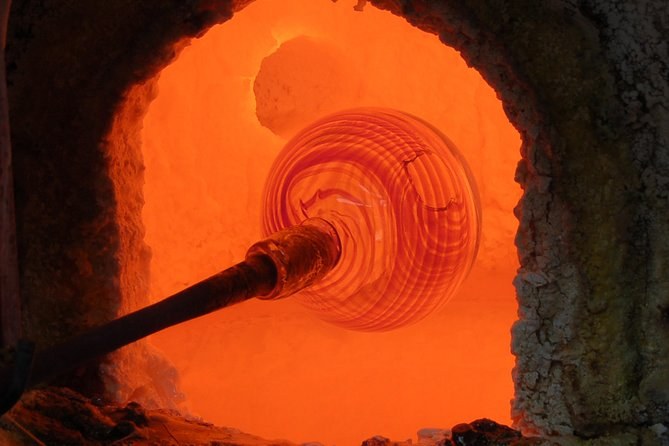
Murano: the furnace
Start where the tour starts. A maestro gathers molten glass on the end of a steel blowpipe, shapes it against a wet wooden block, opens the form with a breath down the pipe, and pulls a neck or a handle with jacks and shears. The whole sequence takes minutes.
Watch the assistant rather than the maestro for a moment. The timing between them is the part that takes years, and it is the thing you cannot see in a finished piece. The Murano glass page has the full sequence.
Murano: Santi Maria e Donato
Ten minutes from the main canal, on the quiet northern fondamenta, is the island’s Veneto-Byzantine basilica. Two things are worth the walk. The floor is a mosaic pavement dated 1141, laid in cut marble and glass, with peacocks and eagles worked into geometric panels. The apse holds a gold-ground mosaic of the Virgin, standing alone against plain gold.
It is free to enter and most tour groups walk straight past it. If your departure gives you ninety minutes or more on Murano, this is where the extra half hour goes.
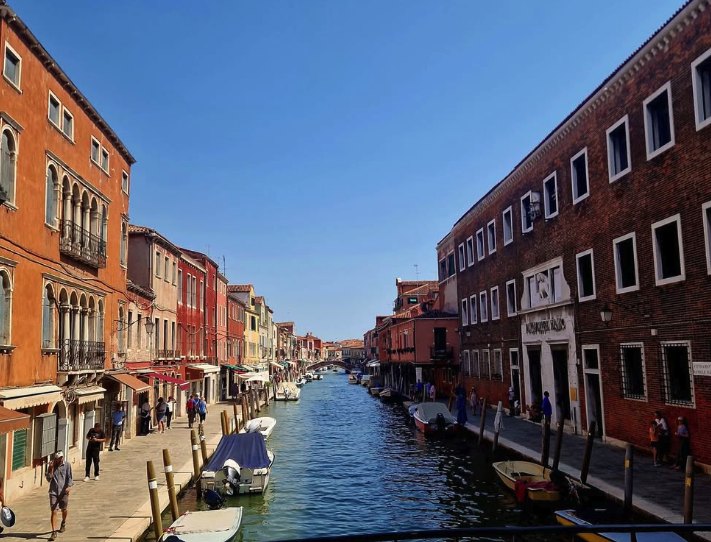
Murano: the Fondamenta dei Vetrai
The main canal frontage, lined with showrooms. It is the commercial face of the island and it is worth walking anyway, because the range between a mass-produced trinket and a signed piece is on display within a hundred metres.
The Museo del Vetro, the civic glass museum, sits further along at Palazzo Giustinian. No departure includes entry, so it is a stop for your own time.
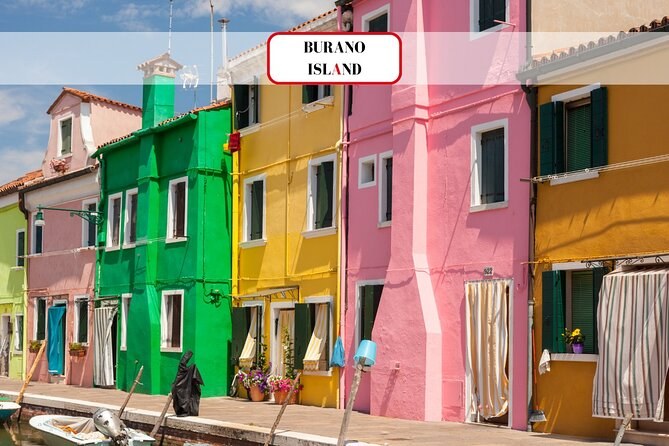
Burano: the painted fondamenta
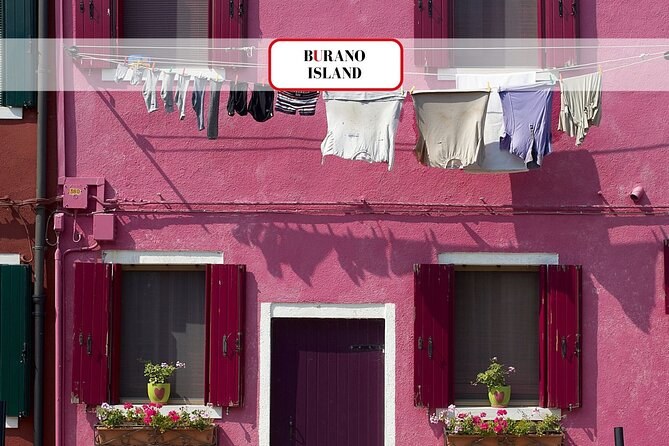
This is the picture everyone has seen, and it holds up. Ochre, rose, cobalt, lime and crimson run the length of the canal, each applied by permission of the comune rather than by whim. Residents apply for a colour and are given a specific shade.
The trick is to keep walking. The main street performs; the lanes behind it do not, and that is where Burano is a place people live rather than a backdrop.
Burano: the leaning campanile
The bell tower of San Martino tilts visibly out of true, settled unevenly into lagoon sediment. From the far side of the main canal the lean is obvious enough to read in a photograph, which is not true of most leaning towers.
Burano: lace, and where it is really from
Piazza Galuppi holds the Museo del Merletto, in the building that housed the lace school founded in 1872 to stop the technique dying out. Burano’s lace is punto in aria — needle lace worked on a thread frame rather than into cloth.
Some of what is sold on the island is made on the island. A good deal is not. Burano lace sets out what to look at before you buy.
Torcello: Santa Maria Assunta
Founded in 639, the cathedral holds the oldest mosaics in the lagoon. The west wall carries a full-height Last Judgement, read from the top down. The apse holds a gold-ground Madonna. Entry is charged separately and is not included in any tour fare.
Outside stands a stone seat known as Attila’s Throne — a local name rather than a historical claim — and a short walk away the Ponte del Diavolo crosses the canal without parapets. Whether Torcello earns its place on a half-day is worked through on its own page.
How much time each stop needs
- Glass demonstration: 5–15 minutes, fixed by the furnace.
- Santi Maria e Donato: 20–30 minutes including the walk.
- Fondamenta dei Vetrai: 20 minutes, more if you are shopping.
- Burano’s painted canals: 45 minutes to do properly.
- Burano’s back lanes: another 30, and the best half hour of the day.
- Santa Maria Assunta: 40 minutes including the walk from the landing.
Which departures leave you time for all of it
| Departure | Time ashore | Rating | From |
|---|---|---|---|
| Murano Glass & Burano Lace Guided Island Visit | About 4 hrs 20 min ashore — Murano 1 hr 15 min, glassworks 50 min, Burano 2 hrs 15 min | 4.7 (1,955) | From $29 |
| Murano & Burano Islands Small-Group Tour by Private Boat | About 2 hrs 30 min at each island, boat transfers included | 4.7 (9,016) | From $51 |
| Murano Glass Experience with a Visit to Burano Lace Island | About 2 hrs on Murano (glassworks, Duomo and free time) and 1 hr 30 min on Burano | 4.5 (1,586) | From $58 |
| Murano, Burano & Torcello Half-Day Boat Tour | Up to 1 hr 30 min per island on the two-island option; about 50 min per island on the three-island option | 4.2 (17,580) | From $28 |
Burano: eating on the island
Burano is where every half-day leaves enough time to sit down, and the restaurants along the canal are the reason a two-hour stop beats a one-hour one. The island’s own thing is risotto de go, made with the goby caught in the lagoon, and the bussolà — a ring-shaped butter biscuit sold by the bag in every second shop.
Prices on the main canal are what you would expect of a view. One street back they are not, and the food is generally the same. Card acceptance is patchy in the smaller places, so carry a little cash.
The order to do it in
Every departure puts Murano first, and that is not an accident. The furnace runs to a schedule and the glassworks slot each arriving group into it, so the first stop is fixed whether or not it suits you.
What that means in practice is that your unstructured time falls on Burano, at the end of the day, when the light is lower and the day-trippers are thinning out. It is the better half to have loose, so the running order works in your favour even though nobody chose it for that reason.
If your route includes Torcello it usually comes last, furthest out, and the walk from the landing eats a good part of the stop. That is the argument for treating it as its own trip rather than a third stop, which is worked through in two islands or three.
Planning around it
Photographs of all three islands are on the gallery, and boats, seasons and access are on visiting the islands. Practical questions are answered on the questions page, and Murano & Burano Islands Tours lists every departure with the time it leaves you ashore.
Which departure gives you the time?
Fares, island time, group size and cancellation terms for every departure, side by side.
Free cancellation up to 24 hours ahead on every departure listed.
Tours that fit this trip
Chosen for what this page covers, not for what sells.