When to Visit Murano & Burano
There is no month the boats stop. What changes is the crowd, the heat, the light and the water — and one demonstration that pauses on winter Mondays.
In this guide
What is the best month to visit?
May, and late September, by some distance. Both give you long light, warm but not punishing afternoons, and islands that are busy rather than crowded. April and October are close behind and cheaper.
There is no month in which the islands are closed or the boats stop. What changes is the crowd, the temperature, the light and the water level.
Month by month
| Month | Crowds | Feel | Light for photographs | Watch for |
|---|---|---|---|---|
| Jan–Feb | Lowest | Cold, often clear | Low, soft, short days | Some closures; carnival crowds in the city |
| Mar | Rising | Cool, changeable | Improving | Lace demo may not run Mondays |
| Apr | Busy | Mild, pleasant | Very good | Easter peaks |
| May | Busy | Warm, comfortable | Best of the year | Book mornings ahead |
| Jun–Aug | Highest | Hot, little shade | Harsh at midday | Heat, sun, sold-out mornings |
| Sep | Busy | Warm, softening | Excellent | Still peak pricing early in the month |
| Oct | Easing | Mild, wetter | Very good, low sun | Acqua alta season begins |
| Nov–Dec | Low | Cool, atmospheric | Short but beautiful | Highest acqua alta risk; Monday lace gap |
Crowd and light are general patterns for planning, not forecasts. Acqua alta is most frequent in autumn but can occur outside it.
How bad is the summer heat?
Manageable with a little planning, and hard work without it. The problem is not the temperature so much as the shade: both islands are open paving and water frontage, and there is very little cover along the canals where you will want to walk.
Travellers mention it in review after review. Take a hat, sun cover and water, and book a morning departure — the difference between ten and two on a July fondamenta is considerable.
What does acqua alta do to a boat tour?
High water is a Venetian phenomenon of autumn and winter, when tide, wind and pressure combine to push the lagoon above its normal level. In the city it floods low-lying squares. Out on the islands it mostly affects the landings.
Operators cancel for exceptional weather or high water and offer another date or a full refund, and every departure here refunds in full up to 24 hours ahead anyway. It is a reason to book flexibly in November, not a reason to avoid the season.
Is winter worth it?
For photographers and for anyone who dislikes crowds, genuinely yes. The islands in January are quiet in a way they never are in May, the light is low and long all day, and Burano's colours against a grey lagoon are better than against a blue one.
The trade is short days and cold on the water. Boats are covered and run in the rain, but a crossing in February is a different proposition from one in June.
Is anything unavailable in the off season?
One specific thing worth knowing: from November to March the lace-making demonstration may not run on Mondays on at least one departure, with the operator substituting a comparable alternative. If Burano lace is a reason you are going, pick another weekday in winter.
Otherwise the schedule holds year-round. Both islands are inhabited and working, not seasonal attractions that shut.
When is the light best?
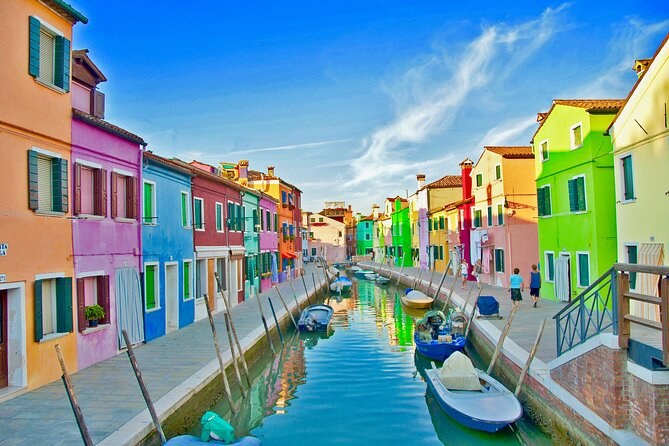
Late afternoon, and it is not close. Burano's painted fondamenta faces the low sun, so the colours saturate in the last two hours of daylight in a way they simply do not at midday.
Murano is less directional and photographs well at any hour, though the canal reflections are best when the water is still, which usually means early.
Morning or afternoon, if you can only pick one?
Morning for the islands, afternoon for the pictures. A morning departure finds Burano before the day-trip boats arrive and Murano before the showrooms fill. An afternoon one trades that quiet for the light.
Families should take the morning without much deliberation; photographers should take the afternoon and accept the company.
When are the islands busiest?
Between about eleven and three, from April to September, and worst on cruise days. The pattern is driven by day-trip departures out of Venice rather than by people staying on the islands, which is why an early boat changes the day so much.
Burano feels the crowding more than Murano because its main street is narrow and the whole island is small.
How far ahead should you book?
In peak season, days rather than weeks — but do book. Morning departures sell out through July and August, and the small-capacity formats sell out first because there are ten or twenty-two places rather than a hundred and fifty.
Out of season a day or two is usually enough. Booking early costs nothing either way, since every departure listed refunds in full at 24 hours and most let you reserve now and pay later.
What changes around Christmas and New Year?
The city gets busy and the islands do not, which makes late December one of the better times to cross the lagoon. Some businesses close for the holidays and daylight is short, so plan a morning and check the return time carefully.
What makes the shoulder seasons so much better?
Three things at once, and they compound. The day-trip volume out of Venice drops sharply either side of summer, so Burano's main street stops being a queue. The temperature moves into the range where an unshaded fondamenta is pleasant rather than punishing. And the sun sits low enough for long enough that the light is good for most of the afternoon rather than one hour of it.
April, May, September and October are the months where you get the islands close to their best without paying for it in heat or crowds. If your dates are flexible at all, aim there.
The catch is that everyone else has worked that out too. Morning departures in May sell out days ahead on weekends, so shoulder season is when booking early actually matters.
Does the weather change what you actually see?
Less than in most destinations, because the two headline experiences are indoors and underground in spirit. A furnace is a furnace in any weather, and a lace demonstration happens under a roof.
What weather changes is the half of the day that is yours: walking Burano's canals in horizontal rain is a different proposition from walking them in April sun. Boats are covered and run regardless, so the decision is about your comfort ashore rather than whether the tour happens.
Does the tide affect anything besides flooding?
Yes, in a way nobody mentions until you are standing on a pontoon. Landings float, so the step between boat and quay changes through the day, and at low water some smaller craft board awkwardly.
It rarely changes a schedule. It is simply worth knowing if anyone in your party is unsteady on their feet, and a reason to accept a hand when the crew offers one.
Are there dates worth planning around?
The city's calendar drives demand on the islands more than the islands' own. Carnival in February and the big summer regattas fill Venice and push day-trip boats to capacity, and Easter does the same for a fortnight.
None of it closes the lagoon or changes what you will see out there. It changes how far ahead you should book and how early you should go, which is the practical point.
What about the lagoon fog?
It is a winter feature rather than a hazard, and it is the one weather condition that genuinely changes what you see. From November to February the lagoon can sit under fog for a morning at a time, which flattens the horizon and hides Venice behind you within minutes of leaving the pier.
Boats run through it. Thick fog occasionally delays a departure while traffic thins, but cancellations are rare and the crossing itself is unaffected.
Whether that is a loss depends on what you came for. The long view back across the water disappears, but Burano's colours against grey water are extraordinary, and the islands are as quiet as they ever get. Photographers tend to book winter mornings deliberately.
Is there a month to avoid?
Not really, but August is the one to think hardest about. It is the hottest, the busiest and the least shaded, and a shadeless fondamenta at two in the afternoon is nobody's best memory of Venice.
If August is when you are travelling, take the earliest departure of the day and give Burano the longer stop. The islands are still worth it; the timing is simply doing more work.
Picked your month?
Every departure, with the time it leaves you ashore and its cancellation terms.
Free cancellation up to 24 hours ahead on every departure listed.
What to wear and how to reach the piers is on visiting the islands. Murano & Burano Islands Tours lists every departure.
Frequently asked questions
What is the best time of year for Murano and Burano?
Do the boat tours run in winter?
Will acqua alta cancel my tour?
When is the light best for photographing Burano?
Is anything closed in the off season?
Tours that fit this trip
Chosen for what this page covers, not for what sells.