10 Surprising Murano & Burano Glass Facts
Murano glass is one of those subjects where the folklore has almost swallowed the record. Here are ten things that hold up, drawn from the island’s own history rather than from the story told in a showroom. If you are booking, every murano glass factory tour in the lineup includes a furnace visit.
1. The furnaces were moved by decree in 1291
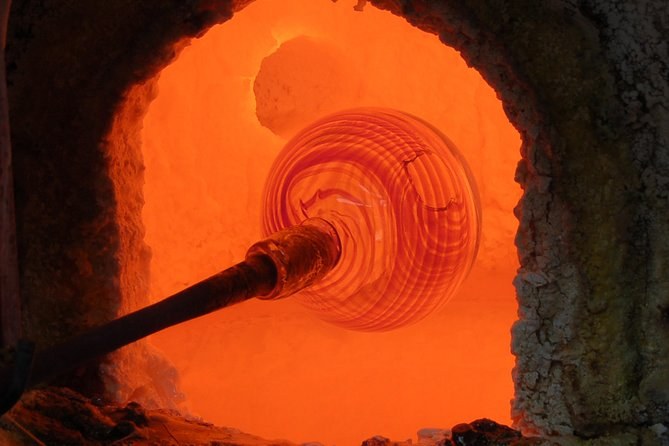
The Venetian Republic ordered the city’s glass furnaces out of Venice proper and onto Murano. The stated reason was fire: a furnace running above 1,000°C inside a dense city built largely of timber was a standing risk.
2. The move concentrated the knowledge, not just the risk
Putting every furnace on one island put every glassmaker on one island too. Techniques that would otherwise have spread stayed put, and the island developed a body of practice nowhere else had. That is the part the fire-safety story leaves out.
3. Glassmasters held unusual standing — and unusual restrictions
Masters were granted civic privileges rare for artisans of the period, and were restricted from carrying the craft abroad. The commonly repeated version, in which defectors were hunted down, is folklore rather than record, and it is worth treating as such.
4. The oldest thing on Murano is not glass
The mosaic pavement inside Santi Maria e Donato is dated 1141, a century and a half before the furnaces arrived. Cut marble and glass, worked into geometric panels with peacocks and eagles, and free to walk across.
5. A demonstration lasts minutes, not hours
The gather, the block, the breath, the jacks: a finished piece takes a maestro five to fifteen minutes. Travellers consistently describe the demonstration as short, and it is. What varies between departures is how much island time you get afterwards.
6. The cooling takes longer than the making
A finished piece goes straight into an annealing oven and comes down slowly over hours. Skip that and the thermal stress cracks it. The furnace floor you walk through is mostly ovens, not blowing benches.
7. There is a trademark, and it is the only reliable test
Vetro Artistico® Murano is the regional trademark that certifies glass actually made on the island. Price is not a test, a Venetian-sounding shop name is not a test, and “Murano style” means the opposite of what it sounds like.
8. Buying inside the furnace is the other reliable route
If you have just watched the piece made, the provenance question answers itself. That is the single practical reason to browse the showroom the demonstration ends in, whatever you think of the sales pitch. The Murano glass page has the full buying checklist.
9. Burano’s craft has the same problem, and the same fix
Lace on Burano is in the position glass is in on Murano: a famous name, a small number of remaining makers, and a lot of imported stock trading on the reputation. Burano lace covers what to look at.
10. The chandeliers are the hardest thing in the building
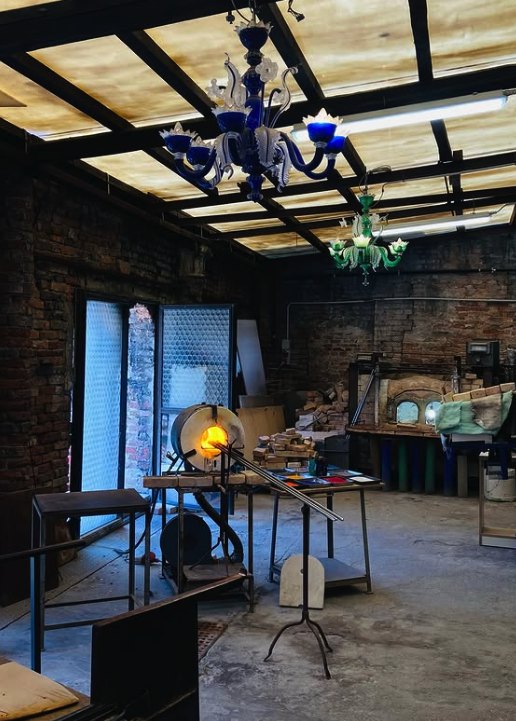
A Murano chandelier is assembled from dozens of individually blown arms, cups and pendants, each made separately and each having to match. Walk into a glassworks and look up: the ones hanging over the working floor are usually the workshop’s own, and they are the best free exhibit on the island.
Where to see it done
| Departure | Group cap | Rating | From |
|---|---|---|---|
| Murano Glass Experience with a Visit to Burano Lace Island | 25 | 4.5 (1,586) | From $58 |
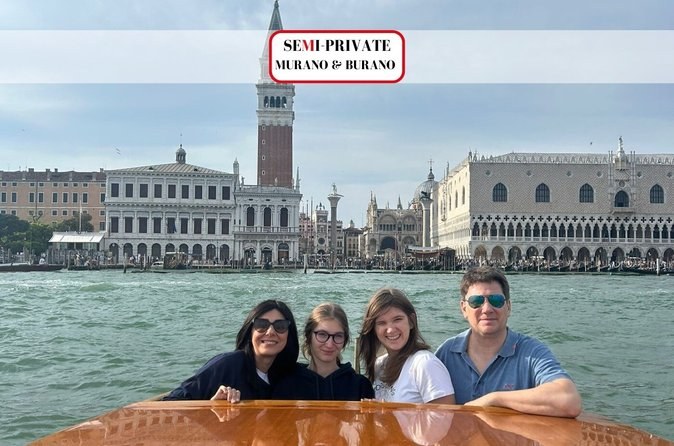
| Semi-Private Murano & Burano Experience | 10 | 4.8 (601) | From $81 |
| Luxury Murano & Burano Private Boat Tour with Guide | Private / not stated | 4.9 (199) | From $340 |
| Murano & Burano Boat Tour with Guide & Glass Factory Visit | Private / not stated | 4.3 (12,517) | From $26 |
Group size decides how much of the demonstration you actually see. A cap of ten means you stand at the bench; a boat of 150 means you watch over shoulders.
Things people get wrong
- “Murano style” is not Murano. It is a phrase used precisely because the real trademark cannot be used.
- Coloured glass is not automatically old. Colour comes from metal oxides added at the furnace and is as modern as it is ancient.
- The demonstration is not a performance for tourists alone. The furnaces are working businesses; the visit is scheduled around production, not the other way round.
- The museum is not included. No departure in the lineup covers entry to the Museo del Vetro.
Why so much of it is blue
Walk any showroom and the palette skews hard towards cobalt blue, gold and clear. That is partly taste and partly chemistry: cobalt is stable, forgiving at furnace temperature and cheap enough to use in volume, which makes it the workhorse colour of the island.
Gold leaf is the other signature, fused between layers of clear glass so it survives the heat. Together they are what most people picture when they picture Murano, and they are why a piece in an unusual colour is often the more interesting buy.
What the colours are made of
Glass is sand, soda and lime; everything else is what makes it interesting. None of it reached Torcello, whose craft was mosaic rather than glassblowing. Colour comes from metal oxides stirred into the batch, and each one behaves differently in the furnace. Cobalt gives the deep blue of the chandeliers. Copper and gold give reds, and gold ruby is still one of the most expensive glasses to make because the gold has to be dissolved before it will colour anything.
Two Murano techniques are worth recognising when you see them. Millefiori builds a picture in cross-section by fusing coloured rods into a cane and slicing it, so every slice carries the same flower. Avventurina suspends fine copper crystals in the glass so the surface reads as though it has been dusted with metal. Both are on sale within a hundred metres of any landing, and knowing the names changes what you look at.
What you will not see in a demonstration is the cold work — the grinding, cutting and polishing that happens after the annealing oven. On a stemmed piece it can take longer than the blowing did, and it is the part of the cost that is invisible in the finished object. If your departure gives you two hours on the island, a workshop on the Fondamenta dei Vetrai will usually let you watch it through the window.
Planning a visit around the glass
Boats, timings and the access fee are on visiting the islands, and the questions page covers what each departure includes. Murano & Burano Islands Tours compares every option by fare and island time.
See a furnace working?
Fares, island time, group size and cancellation terms for every departure, side by side.
Free cancellation up to 24 hours ahead on every departure listed.
Tours that fit this trip
Chosen for what this page covers, not for what sells.